


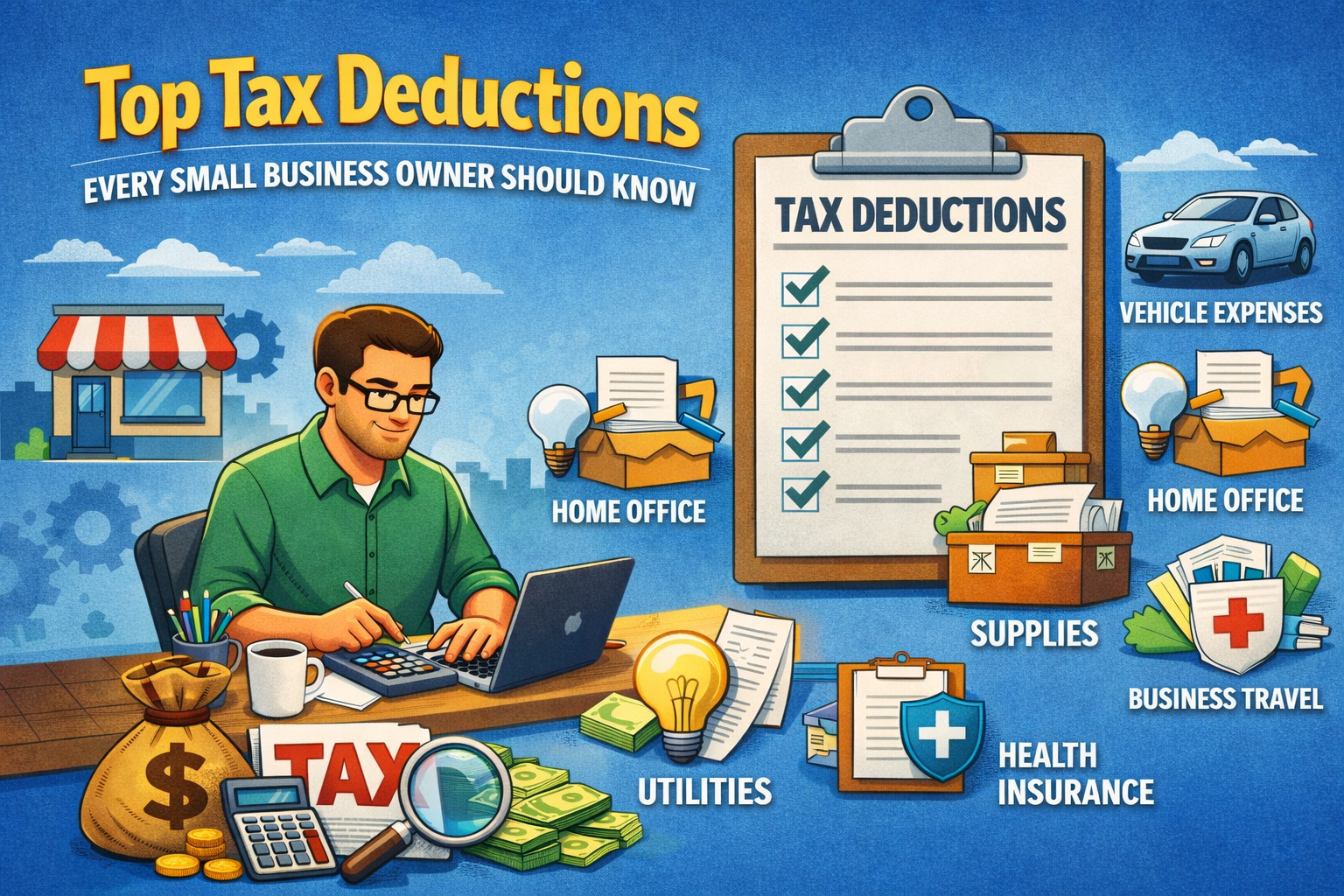
Small business taxes reward one thing: documented, legitimate spending tied to your business. If we’re contractors, real estate investors, or running any service-based business, deductions aren’t optional details—they’re the difference between a painful tax bill and a controlled one.
Below are the deductions that move the needle, plus exactly what we need to track so they hold up.
The Non-Negotiable Standard: “Ordinary” and “Necessary”
Every deduction we claim must be ordinary and necessary for our trade or business. “Ordinary” means common and accepted in the industry. “Necessary” means helpful and appropriate (not necessarily required). IRS ITAP
1) Home Office Deduction (Self-Employed Only, Done Right)
If we use part of our home regularly and exclusively for business, we may qualify for the home office deduction. The IRS recognizes multiple home types (house, apartment, condo, even certain structures on the property). irs.gov+1
Two ways to claim it
- Simplified method: $5 per square foot, up to 300 sq ft (max $1,500). irs.gov
- Actual expense method: Allocate real expenses (rent/mortgage interest, utilities, insurance, repairs, etc.) based on business-use percentage. irs.gov
Records we keep
- A simple floor plan or measurement for square footage
- Utility bills, insurance, rent/mortgage statements
- Repair invoices (note what area they apply to)
2) Vehicle Expenses: Standard Mileage vs. Actual Costs
Vehicle deductions are one of the most abused—and most profitable—when we track them correctly.
Standard mileage rate
For 2025, business mileage is 70 cents per mile. irs.gov+1
For 2026, it rises to 72.5 cents per mile starting January 1, 2026. irs.gov
Actual expense method
We deduct the business-use share of:
- gas, oil, repairs, tires
- insurance, registration, lease payments
- depreciation (if eligible)
Records we keep
- A mileage log with date, destination, purpose, miles
- Receipts for repairs/fuel (if using actual method)
- Proof of business-use percentage
3) Business Meals (50% Rule + Clean Documentation)
Business meals are generally deductible, but the default limit is 50% in most cases. The IRS confirms the prior temporary 100% restaurant rule expired; generally, meals remain subject to the 50% limitation. irs.gov+1
We document every meal like this
- Who we met with (client/prospect/partner)
- Where it happened
- Date
- Business purpose
- Receipt + notes (even short notes are fine)
Important edge case
Food purchased during entertainment can still be deductible if it’s bought separately or separately stated from entertainment costs. irs.gov
4) Advertising and Marketing (One of the Cleanest Deductions)
If it promotes the business, it’s usually deductible:
- website hosting, domain, landing pages, SEO tools
- Google Ads, Meta Ads, TikTok ads
- design, printing, signage, vehicle wraps
- brand photography/video production
- email marketing platforms, CRM costs
Records we keep
- Invoices and ad platform statements
- Contractor agreements (designers, editors, agencies)
- A folder showing what the ad promoted (screenshots are fine)
5) Software, Subscriptions, and Tech Stack
Most businesses bleed money through subscriptions. The good news: many are deductible when business-related.
- accounting software, payroll services
- cloud storage, email suites
- industry tools (construction estimating, property management software, scheduling tools)
Do this ruthlessly
- Audit subscriptions monthly
- Cancel what we don’t use
- Keep receipts for what remains
The IRS maintains a guide mapping business-expense topics to the right resources (Publication 535 is discontinued, but the rules remain—just reorganized across IRS materials). irs.gov
6) Contractors, Freelancers, and Outsourced Labor
If we pay people to help run the business, those costs are often deductible:
- subcontractors (construction trades, installers)
- virtual assistants, editors, designers
- bookkeeping and admin support
- property management fees (for investors)
Records we keep
- invoices, contracts, proof of payment
- W-9 collection process for US contractors (administrative, but worth it)
7) Insurance Premiums We Can Deduct
Common deductible categories include:
- general liability
- professional liability (E&O)
- commercial auto
- business property insurance
- cyber liability (increasingly common for modern operations)
We keep
- policy documents and premium invoices
- proof of payment
8) Self-Employed Health Insurance (Form 7206)
If we’re self-employed, we may be able to deduct health insurance premiums (including medical/dental/vision and qualified long-term care) using Form 7206. irs.gov+1
Records we keep
- monthly premium statements
- proof the plan is established under the business (as applicable)
- notes for eligibility rules (especially if a spouse has employer coverage)
9) Retirement Plans That Reduce Taxable Income
For entrepreneurs, retirement contributions can be one of the largest legal tax reducers:
- SEP IRA
- Solo 401(k)
- other qualified plans depending on business structure
We pair this with clean bookkeeping so contributions are calculated and reported correctly (especially with variable income years).
10) Education, Certifications, and Training (When It Qualifies)
Work-related education is deductible when it maintains or improves skills for our current work—or is required to keep our current position/status—but it cannot qualify us for a new trade or business. irs.gov
Deductible examples (when aligned with current work):
- continuing education courses
- technical training and certifications
- industry conferences and seminars
- required licensing renewals
Records we keep
- course invoice, syllabus/title, proof of completion
- a short note stating how it relates to current business services
11) Travel Expenses (When It’s Truly Business Travel)
Business travel can include:
- airfare, hotels, rideshare, car rentals
- baggage fees
- business-related incidentals
Meals while traveling typically fall under the same 50% rule. irs.gov+1
Records we keep
- itinerary, receipts, and a short business purpose statement
- meeting calendar entries or event registration confirmations
12) Startup Costs (First-Year Deduction + 180-Month Amortization)
When we launch a new business, certain startup expenditures can be recovered via a first-year deduction and then amortized over 180 months (depending on classification and election rules). The IRS framework is reflected in the regulations. Institut d’information juridique
Track carefully
- pre-launch marketing
- legal/accounting setup work
- market research and initial operating planning
(Keep these separate from asset purchases, which may fall under depreciation rules.)
13) Section 179 Expensing (Big Equipment Write-Offs)
If we buy qualifying business equipment, Section 179 can allow accelerated expensing.
For tax years beginning in 2025, the IRS instructions and revenue procedure reflect a maximum Section 179 expense deduction of $2,500,000, with a reduction starting when qualifying property placed in service exceeds $4,000,000. irs.gov+1
Records we keep
- invoices showing purchase date and placed-in-service date
- proof of business use percentage
- asset list (model, serial number if applicable)
14) The Qualified Business Income (QBI) Deduction (Up to 20%)
Many owners of sole proprietorships, partnerships, and S corporations may qualify for the QBI deduction (Section 199A), potentially allowing a deduction of up to 20% of qualified business income (plus certain REIT/PTP amounts where applicable). irs.gov
This is not a “receipt-based” expense—it’s a structural deduction tied to how the business reports income, wages, and property, so clean reporting matters.
Recordkeeping That Makes Deductions Stick
If we want deductions to survive scrutiny, we standardize documentation:
- one business bank account + one business card
- monthly bookkeeping reconciliation
- receipts stored digitally with naming rules (date_vendor_amount_purpose)
- mileage tracking app or spreadsheet updated weekly
- a “tax folder” by category: Home Office, Auto, Meals, Advertising, Contractors, Insurance, Travel, Education, Assets
This isn’t busywork. It’s how deductions become defensible instead of hopeful.
Ready to Stop Overpaying and Get Your Deductions Organized?
If we’re serious about keeping more of what we earn, we don’t “guess” deductions—we structure them. That means clean books, proper categorization, airtight documentation, and a plan that matches our income, entity type, and goals.
RJL Consulting NY helps small business owners, contractors, and real estate investors set up the systems that make deductions real—not risky.
- Explore RJL Consulting NY services: rjlconsultingny.com/services
- Book an appointment: rjlconsultingny.com/appointment
Book the appointment first if taxes are coming up, your books are behind, or you’re unsure what you can safely deduct.
